
car tech
For decades, cars represented freedom. You got behind the wheel, rolled down the windows, and went wherever you wanted without much thought about who — or what — was watching. But that relationship between drivers and vehicles is rapidly changing, and many experts believe the next generation of cars may become some of the most sophisticated surveillance devices Americans own.
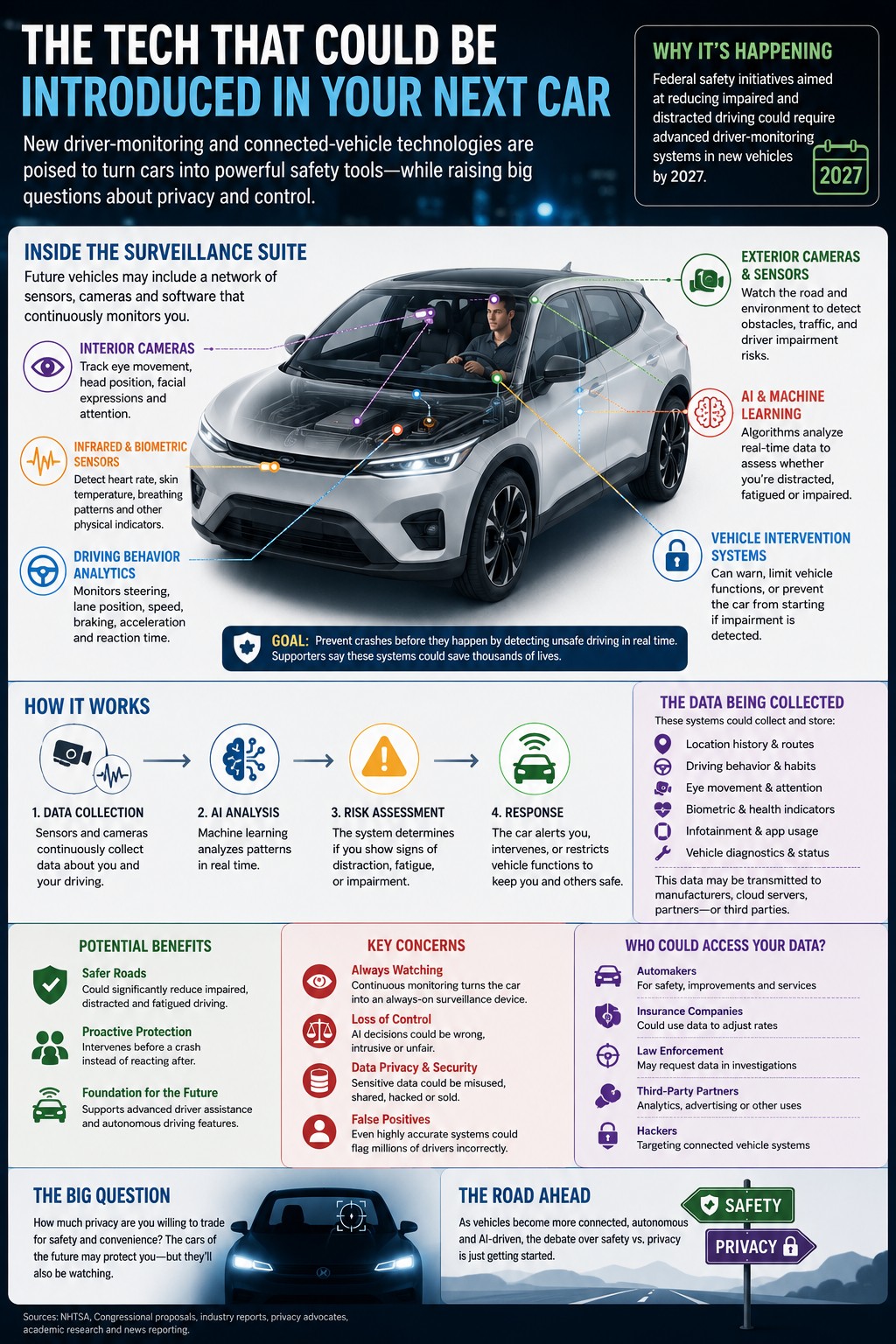
A growing national debate has erupted around new driver-monitoring technologies expected to become standard in future vehicles. Federal safety initiatives tied to impaired-driving prevention could require automakers to install advanced systems capable of monitoring driver behavior in real time by 2027. These systems use cameras, infrared sensors, artificial intelligence, and biometric tracking to analyze whether a driver appears distracted, fatigued, intoxicated, or otherwise impaired.
Supporters argue the technology could save thousands of lives. Drunk and distracted driving remain major causes of fatal crashes across the United States, and safety advocates say proactive monitoring systems could prevent accidents before they happen. Instead of reacting after dangerous driving occurs, future vehicles may intervene immediately by issuing warnings, limiting vehicle functions, or even preventing a car from starting altogether if impairment is detected.
But critics say the technology crosses a line that Americans may not fully understand yet.
Unlike traditional safety systems such as airbags or anti-lock brakes, these new systems continuously observe the driver. Cameras can track eye movement, head position, attention span, blinking patterns, and steering behavior. Some proposed technologies could eventually monitor heart rate, breathing patterns, or other physical indicators. Privacy advocates argue this transforms the car from a transportation tool into an always-on monitoring device.
One of the biggest fears centers around control. If artificial intelligence systems determine whether someone is “fit” to drive, critics worry about false positives and machine-made decisions interfering with everyday life. Something as simple as driving while tired after work, looking away briefly, or appearing stressed could potentially trigger warnings or restrictions depending on how sensitive the system becomes.
Even federal safety officials have acknowledged the challenge. According to reporting on the issue, transportation regulators noted that even systems with extremely high accuracy rates could still generate millions of false positives annually simply because of the enormous number of drivers on American roads every day.
Beyond the immediate driving experience, another question keeps surfacing: where does all the data go?
Modern vehicles already collect huge amounts of information, including location history, driving speed, braking habits, navigation routes, maintenance diagnostics, and infotainment usage. Many connected vehicles upload portions of that information to cloud-based systems operated by manufacturers. New driver-monitoring systems would dramatically increase the amount of behavioral data collected inside vehicles.
That has sparked fears about how the data could eventually be used. Privacy groups worry insurers could use driver-behavior data to adjust rates. Law enforcement agencies could potentially request access to vehicle records during investigations. Hackers may target connected systems storing sensitive information. Meanwhile, cybersecurity researchers have already demonstrated how location histories and other vehicle data can sometimes be extracted from connected cars.
The concerns are not entirely theoretical anymore. Researchers examining connected vehicle systems have warned that some modern cars already broadcast signals capable of revealing location information, while newer electric vehicles increasingly function more like rolling computers than traditional automobiles.
Automakers, however, argue that software-driven vehicles are the future. Advanced driver assistance systems, automatic emergency braking, adaptive cruise control, and lane-centering technologies all rely on increasing amounts of data and automation. Industry leaders believe AI-powered systems will eventually make roads dramatically safer while improving navigation, maintenance, and autonomous driving capabilities.
Some researchers believe society may already be becoming desensitized to automotive surveillance. A recent academic study examining autonomous vehicle users found many drivers viewed in-car monitoring as simply another extension of the broader digital surveillance already normalized through smartphones, apps, smart homes, and online platforms.
Still, the emotional reaction many drivers have toward surveillance inside vehicles feels different because cars occupy such a personal space in everyday life. For millions of Americans, driving represents privacy, independence, and personal control. The idea that a car may constantly evaluate its owner’s behavior — and potentially override human decisions — creates discomfort that goes beyond ordinary technology debates.
At the center of the issue is a difficult balancing act between safety and freedom. Few people oppose reducing drunk driving deaths. But many remain uneasy about handing that responsibility to software systems capable of watching, recording, analyzing, and reacting to human behavior every time someone gets behind the wheel.
As vehicles become more connected, autonomous, and AI-driven, the future of driving may involve more than horsepower and fuel economy. It may also force Americans to decide how much privacy they are willing to trade for convenience and safety.