

How to Use AI to Create a Budget (Even If You’ve Never Budgeted Before)

Budgeting has a reputation for being difficult, time-consuming, and restrictive. For many people, it means sorting through bank statements, tracking every purchase, and wondering why there’s never as much money left at the end of the month as expected.
Fortunately, artificial intelligence is changing that.
AI can analyze your spending, organize expenses into categories, identify spending habits, recommend realistic savings goals, and even act as a personal budgeting coach. While it won’t replace a financial advisor or make financial decisions for you, it can take much of the frustration out of creating and maintaining a budget.
If you’ve never budgeted before—or you’ve tried and failed—AI can make the process much easier.
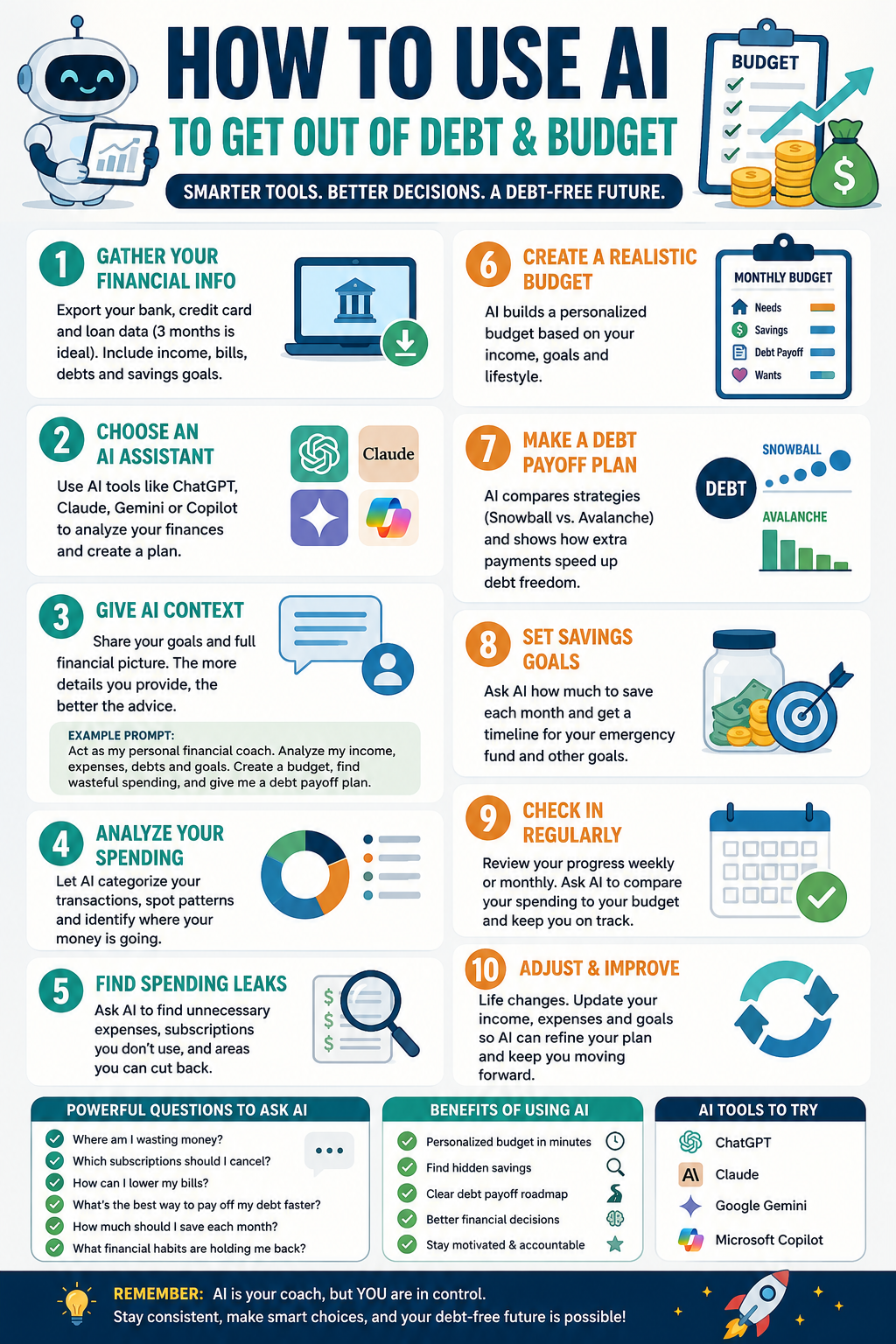
Start by Gathering Your Financial Information
Before asking AI to build a budget, collect some basic financial information. The more accurate your information is, the more personalized the recommendations will be.
Gather your monthly take-home income, recurring bills, debt payments, savings balances, and at least three months of bank and credit card transactions. If you have specific financial goals, such as paying off debt, building an emergency fund, or saving for a vacation, include those as well.
Most banks allow you to export your transaction history as a spreadsheet or CSV file. Before uploading anything, remove sensitive information such as account numbers or personal identification details.
Choose an AI Assistant
Several AI assistants are capable of helping with budgeting, including ChatGPT, Claude, Google Gemini, and Microsoft Copilot.
Each can review your spending, answer financial questions, and generate personalized budget recommendations. The experience is similar across platforms, so choosing one often comes down to personal preference.
Give AI Plenty of Context
One of the biggest mistakes people make is asking AI something vague like, “Create a budget for me.”
Instead, explain your financial situation.
Include your monthly income, regular expenses, debts, savings goals, and any major upcoming expenses. The more information AI has, the more useful its recommendations will be.
Here’s an example prompt you can use:
Act as my personal budgeting coach. Review my monthly income, recurring bills, debts, savings goals, and spending history. Organize my expenses into categories, identify unnecessary spending, recommend a realistic monthly budget, estimate how much I can save each month, and explain your recommendations. Ask follow-up questions before making assumptions.
This prompt encourages AI to ask questions instead of guessing, leading to more accurate advice.
Let AI Analyze Your Spending
Once you’ve provided your financial information, AI can quickly organize your spending into useful categories.
Typical categories include housing, transportation, groceries, restaurants, entertainment, shopping, healthcare, subscriptions, debt payments, and savings.
Seeing your spending organized this way often reveals patterns that are difficult to notice when simply reviewing bank statements.
For example, you may discover you’re spending more on takeout than groceries, or that several small subscriptions are quietly adding up each month.
Find Hidden Spending
One of AI’s biggest strengths is identifying recurring expenses that are easy to overlook.
Ask questions such as:
Where am I spending more than I realize?
Which subscriptions could I cancel?
What purchases happen repeatedly?
Which expenses have increased over the past few months?
Where could I realistically reduce spending without affecting my lifestyle?
These insights often uncover hundreds of dollars in potential savings over the course of a year.
Build a Budget That Fits Your Lifestyle
A good budget shouldn’t force you to give up everything you enjoy.
Instead of creating an unrealistic spending plan, ask AI to recommend a budget based on your actual habits.
If you enjoy eating out occasionally or spending money on hobbies, tell AI. It can adjust your budget while still helping you reach your financial goals.
The goal isn’t perfection. The goal is creating a budget you can actually stick to.
Set Savings Goals
AI can also help you determine how much you should save each month.
Ask questions like:
How long will it take to build a six-month emergency fund?
How quickly can I pay off my credit card debt?
Should I pay extra toward my loan or save more money?
How much can I comfortably save each month?
AI can calculate different scenarios and show how changing your monthly savings or debt payments affects your timeline.
Check In Every Week
Budgeting shouldn’t happen only once a month.
A quick weekly review can help you stay on track.
Simply ask AI to compare your spending for the week with your monthly budget and identify any areas where you’re overspending.
Making small adjustments throughout the month is much easier than trying to fix an entire month’s worth of overspending.
What AI Does Well
AI is especially useful for organizing expenses, identifying spending patterns, creating customized budgets, explaining financial concepts, tracking savings progress, and suggesting practical ways to reduce unnecessary spending.
It can also answer questions whenever you need clarification, making it feel more like a financial coach than a budgeting spreadsheet.
Understand Its Limitations
Although AI is an excellent budgeting assistant, it isn’t perfect.
It doesn’t know your personal priorities unless you explain them. It can’t predict unexpected expenses, and it shouldn’t replace professional financial advice for complex situations involving taxes, investing, or legal matters.
Always review AI’s recommendations before making important financial decisions.
Tips for Better Results
Provide several months of spending history whenever possible.
Be honest about your spending habits.
Include upcoming expenses such as vacations, holidays, or home repairs.
Ask follow-up questions if something doesn’t make sense.
Update your budget regularly as your income or expenses change.
The more information you provide, the more valuable AI becomes.
Final Thoughts
Artificial intelligence isn’t a magic solution, but it is an incredibly useful tool for anyone looking to take control of their finances.
Instead of spending hours organizing transactions and building spreadsheets, AI can analyze your spending in minutes, uncover money leaks, recommend realistic budgets, and help you develop better financial habits.
The best budget is one you can consistently follow. AI can help you build that budget, adjust it as your life changes, and keep you focused on your financial goals.
Whether you’re trying to save more, pay off debt, or simply understand where your money goes each month, AI can make budgeting easier than ever before.

Owner of 9malls.com